Mediterranean Observer
If you run or advise a tourism business in the Mediterranean, you are already on the frontline of climate risk, water scarcity and changing visitor expectations— even if you do not call it “sustainability” yet. At the same time, standards like GSTC, EU Ecolabel, ISO 14001 and Green Key are reshaping how destinations compete for guests, investors and public funding.
To help tourism SMEs, consultants, certification bodies and other professionals turn this reality into opportunity, the EU co-funded project Sustainable Ecotourism Awareness (SEA) has created a six‑module, 40‑hour training course on Green Tourism, Sustainable Management and Green Certification. It is designed specifically for the needs of smaller operators and advisors who must combine daily operational pressures with long‑term sustainability and certification goals.
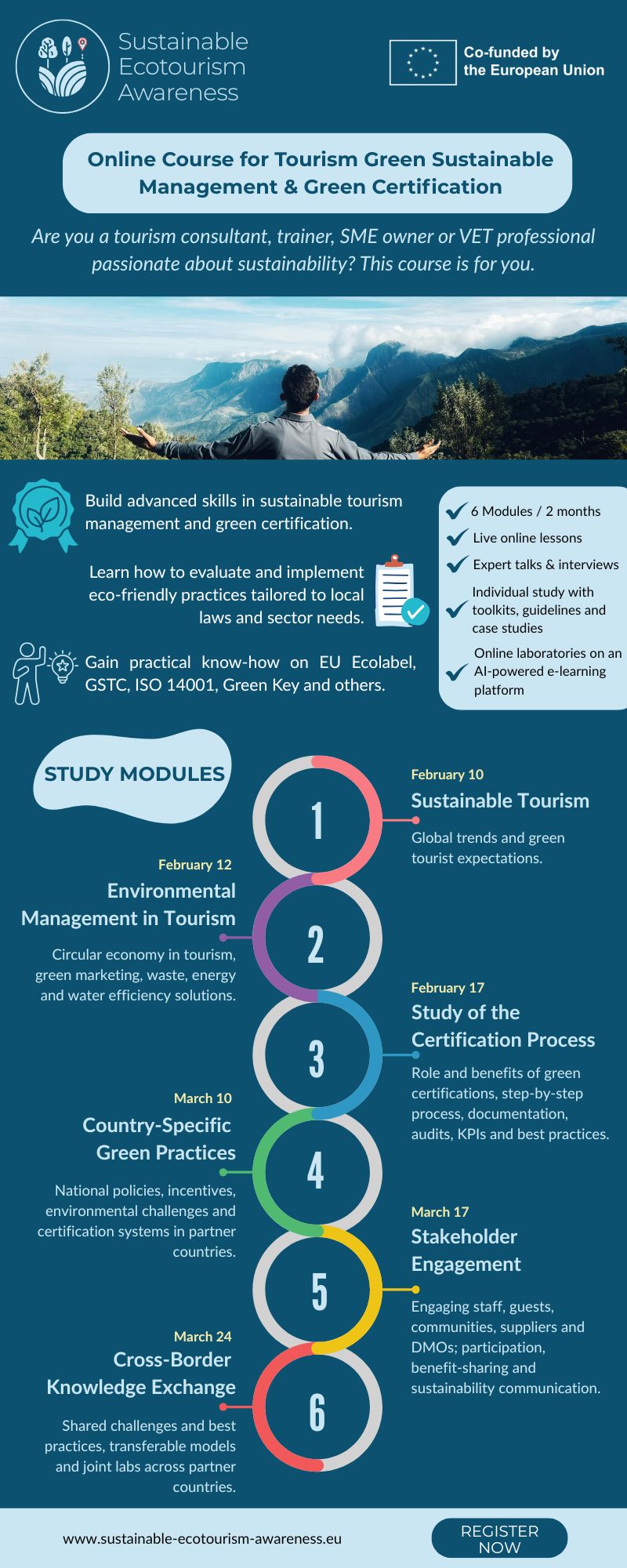
Across six modules, the course moves from the fundamentals of sustainable tourism to advanced topics like carbon accounting, country‑specific policies, inclusive supply chains and EU funding opportunities for tourism SMEs. It blends recorded online lessons, expert video talks and individual study toolkits so participants can learn the concepts, see them applied in real cases from Malta, Türkiye and beyond, and then adapt them to their own context.
The content of the course is open — and it’s free
The live edition of the course has concluded, but all content remains fully accessible online. Watch the classes on YouTube whenever you have time.
Module 1 – Introduction to the Course and Sustainable Tourism
Module 1 reframes sustainability from a peripheral “green hobby” into a core strategic management approach and survival requirement for tourism businesses. Using examples such as Crete’s seasonal “popcorn effect” and the concept of carrying capacity, the module shows how unmanaged peaks in visitors can strain water, energy, food and infrastructure far beyond local limits.
Participants learn to work with the three pillars of sustainability—environmental, social and economic—and to recognise issues like cultural co14mmodification, seasonal job insecurity and short‑term profit thinking as real business risks. In practice, this means starting to track basic indicators (energy, water, waste per guest night), questioning existing design choices, and viewing staff training as a risk management tool rather than a one‑off awareness session.
Featured voices (watch by focus):
Assoc. Prof. Halil Burak S. Sakal – Cappadocia University · Lesson: Introduction to the course and sustainable tourism (Parts 1–3). Focus: Strategic management view of sustainability and three‑pillar basics for tourism SMEs.
Massimo Mercuri – Co‑founder of Think Tank AlterContacts · Video Talk: Introduction to Sustainable Tourism. Focus: Big‑picture business case, carrying capacity and the “popcorn effect” in Mediterranean destinations.
Module 2 – Environmental Management in Tourism
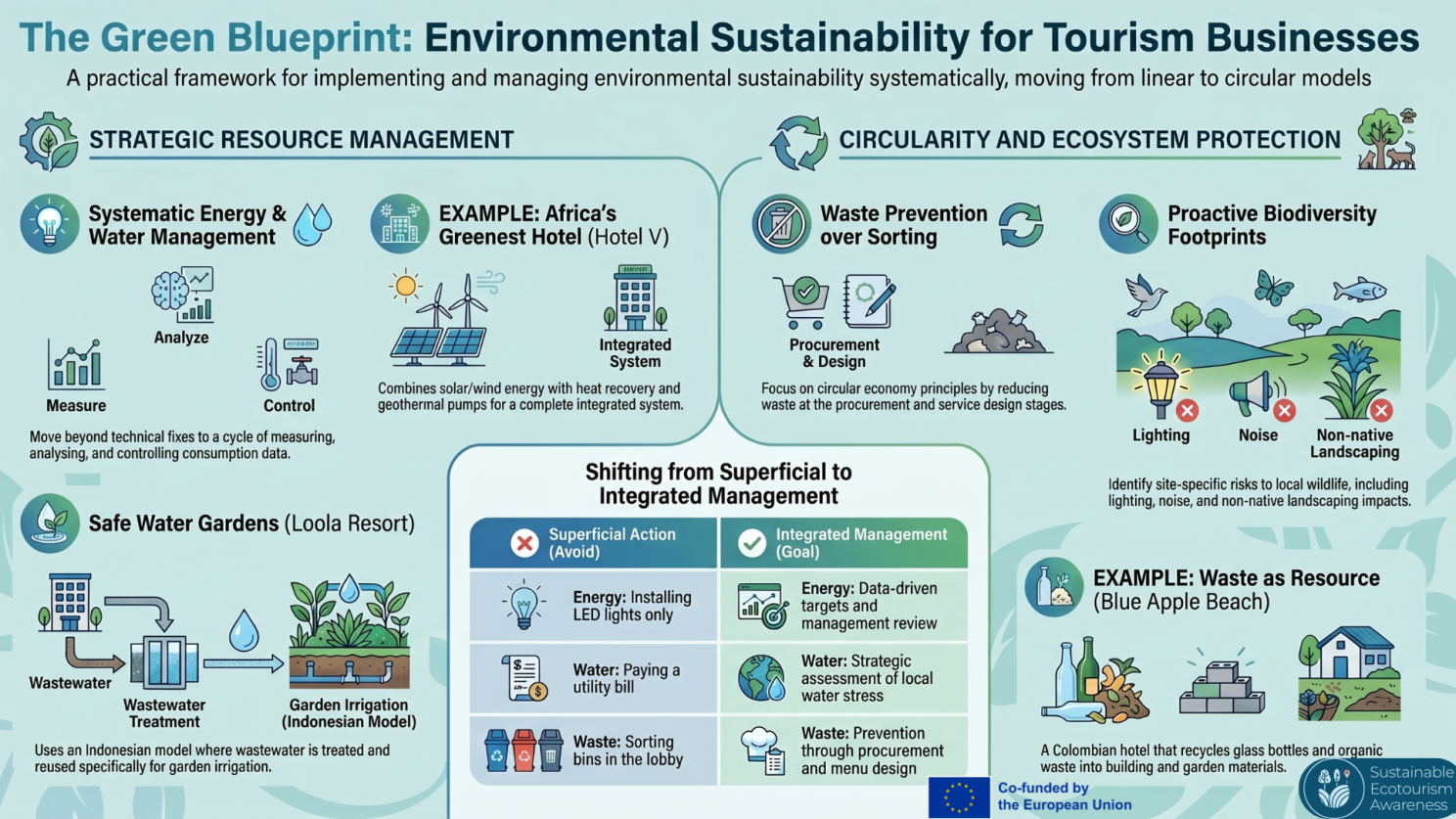
Module 2 dives into environmental management in tourism, helping SMEs understand EU sustainability policies and translate them into day‑to‑day actions on energy, water and waste. The module explains circular economy principles, green marketing and the use of tools like decentralised metering and the Weaver indices to monitor performance at the level of departments and destinations.
For Mediterranean operators, this is where the course becomes very concrete: you see how to start with “baby steps”—such as measuring energy use in the kitchen or tracking pool water losses—and gradually build toward more ambitious “extreme green” strategies embedded in your business model and supply chain. The video talks with GSTC leadership and carbon accounting experts show how carbon footprint measurement and reporting are becoming essential for accessing finance, corporate contracts and higher visibility on digital platforms.
Featured voices (watch by focus):
Prof. Roberto Micera – University of Basilicata · Lesson: Environmental management in tourism and green marketing. Focus: Overall environmental strategy, KPIs and green marketing for destinations and hotels.
Dr. CB Ramkumar – Vice‑Chair, Global Sustainable Tourism Council (GSTC) · Video Talk: Importance of sustainability management in tourism businesses. Focus: Turning GSTC criteria into simple, daily routines for small and medium hotels.
Dr. Levent K. Köseoğlu – CEO, cOmmitted · Video Talk: Importance of carbon footprint measurement, reporting and offsetting. Focus: Carbon accounting (Scopes 1–3), offsets and upcoming carbon‑related risks for tourism.
Module 3 – Making Green Certification Achievable for SMEs
Many tourism businesses see certification as either too complex or too distant from daily realities; Module 3 is designed to change that. It offers a clear, step‑by‑step roadmap: starting from gap analysis and the creation of a cross‑functional “green team,” then moving through implementation, internal checks, and finally external audits for schemes such as EU Ecolabel, GSTC, ISO 14001 and Green Key.
The lessons and presentations explain how to choose certification schemes that match your current capacity, how to structure a digital evidence portfolio of KPIs and invoices, and how to integrate certification requirements into routine operations rather than treating them as a separate project. The module also stresses the business case: certified performance can improve operational efficiency, reduce regulatory risk, and open doors to B2B markets and green finance that increasingly demand credible sustainability data.
Featured voices (watch by focus):
Laura Sue Armeni – Director, Risk Management, Policy & EU Affairs, Authority for Transport in Malta · Lessons 1 and 3: Certification processes and market advantage. Focus: Choosing the right scheme (EU Ecolabel, GSTC, ISO 14001, Green Key), PDCA and avoiding documentation fatigue.
Assoc. Prof. Mehmet BAHAR, Ph.D. – Head of Sustainable Tourism Masters Program, Cappadocia University · Lesson 2: Practical process of obtaining green certification. Focus: Implementing criteria on‑site, building the evidence portfolio and preparing for internal and external audits.
Dr. Levent K. Köseoğlu – CEO, cOmmitted · Video Talk: Carbon footprint and sustainable practices in hotels. Focus: Designing carbon‑related practices that support credibility and long‑term certification resilience.
Module 4 – Learning from Malta, Türkiye and other Mediterranean cases
Sustainability cannot be copy‑pasted; what works in a water‑stressed micro‑island like Malta will differ from what is effective in Türkiye’s large, diverse tourism landscape. Module 4 therefore focuses on country‑specific green practices, comparing voluntary incentive models with mandatory GSTC‑aligned certification programs, and discussing how national policies, funding and infrastructure shape what SMEs can realistically do.
Case studies include Malta’s shift from “volume to value,” regenerative farming at Xara Gardens, and pioneering carbon‑neutral accommodations, alongside Türkiye’s national sustainable tourism program and its staged approach to raising standards across all facilities. Additional video talks explore inclusive supply chains, the role of certification bodies and hands‑on EU Ecolabel experiences, providing practical insights into how labels function in real businesses.
Featured voices (watch by focus):
Prof. Tonio Cini – Operations Executive, Malta Hotels & Restaurants Association (MHRA) and Administrator, Mediterranean Tourism Foundation · Lesson 1: Sustainable tourism in Malta. Focus: Malta’s certifications, water‑scarcity challenges and hotel‑level best practices.
Prof. Avşin Ayhan – Cappadocia University · Lesson 2: Sustainable tourism in Türkiye. Focus: Türkiye’s mandatory national sustainability certification program, criteria and financial incentives for businesses.
Dr. Piera Buonincontri – Senior Researcher, CNR‑ISMed · Lesson 3 and Video Talk: EU Ecolabel experiences. Focus: Italian certification landscape, EU Ecolabel criteria and concrete examples from Italy and Germany.
Professor Roya Rahimi, SFHEA, MIH, FInstTT – Tourism and hospitality scholar · Video Talk: Inclusive supply chain management in tourism. Focus: Inclusive supply chains, women‑led tourism SMEs and post‑earthquake recovery in Hatay.
Tugce Tapan Yünlü – Certification Manager, Control Union Certifications · Video Talk: The role of certification bodies in sustainable tourism. Focus: How certification bodies operate, evolving standards and what auditors look for in practice.

Module 5 – Stakeholder Engagement as a Lever for Green Transformation
Module 5 treats stakeholder engagement not as a generic slogan, but as a structured process to manage power dynamics, expectations and collaboration in tourism destinations. Participants work with tools such as stakeholder mapping, empathy mapping and design thinking, illustrated through cases like the SDG Acceleration Action mOther Earth in rural Spain and stakeholder processes in Cappadocia.
For Mediterranean SMEs and consultants, the key message is that successful green transformation—and often successful certification—depends on genuine involvement of staff, suppliers, communities, destination management organisations and local authorities. The module shows how to build trust, handle resistance, and align sustainability initiatives with economic and social value creation so that local actors see themselves as co‑owners of the process.
Featured voices (watch by focus):
Julia K. Skupchenko – Co‑founder of Think Tank AlterContacts · Lesson: Stakeholder engagement in tourism. Focus: Stakeholder mapping tools, empathy mapping and the mOther Earth case study in rural Spain.
Dr. Tibethan Memisoglu – Ahiler Development Agency (AHIKA) · Video Talk: Sustainable Tourism in Cappadocia. Focus: Stakeholder engagement and green transformation roadmap for Cappadocia.
Prof. Raffaele Crispino – CEO, Project & Planning; Adjunct Professor, University Magna Graecia · Video Talk: How tourist destinations can grow economically while protecting resources. Focus: Destination marketing, innovation and active community involvement in sustainable tourism.
Module 6 – Cross-Border Knowledge Exchange
The final module, built around simultaneous laboratories in Malta, Italy and Türkiye, focuses on cross‑border knowledge exchange and connection with EU policy frameworks. Through an in‑depth video talk, participants learn about EU Cohesion Policy 2021–2027, the EU’s strategy for a greener and more digital tourism sector, and specific funding instruments such as the COSME/SMP call for tourism SMEs.
This module helps participants identify how their own projects—such as sustainable routes, regenerative hospitality concepts or community‑based initiatives—can be positioned within EU priorities and funding schemes. It also reinforces the idea that Mediterranean destinations share many challenges and have much to gain from structured, cross‑border collaboration on sustainability indicators, business models and training.
Featured voices (watch by focus):
Dr. Daniela de Gregorio – EU Grant Manager, Institute for the Study of the Mediterranean (CNR‑ISMed) · Video Talk (4 parts): EU Cohesion Policy, the future of European tourism and COSME/SMP. Focus: EU policy context, funding opportunities for tourism SMEs and how to position green and digital projects for support.
How to make the most of the SEA course
Use Module 1 to review your current approach to sustainability and identify blind spots in environmental, social or economic pillars.
Apply Module 2 to set up or refine your basic KPIs for energy, water and waste, and explore where small metering changes can yield big insights.
Leverage Module 3 when planning or updating your certification roadmap, especially to align your choice of label with your organisational maturity and market strategy.
Draw on Module 4 and Module 6 to position your projects within national frameworks and EU priorities, including funding opportunities for SMEs.
Engage your team and territory using the tools from Module 5 to strengthen buy‑in and co‑create solutions with local stakeholders.
All of this content is already available online, ready to support your next steps in building a more resilient, competitive and genuinely sustainable tourism offer in the Mediterranean.
What’s next? If your tourism business in Italy, Malta or Türkiye — this is for you.
The next phase of the project moves from training to action. In Italy, Malta and Türkiye, tourism SMEs and operators can now access direct mentoring and consulting support to help them assess their current sustainability practices, close the gaps, and prepare for an actual green certification submission. This is hands-on, practical guidance — not a classroom — delivered by local experts in your language and tailored to your national regulatory context.
If you work with tourism SMEs, public authorities, destination management organisations, certification bodies or consulting firms in the Mediterranean, this is an opportunity to equip your teams with a shared language, practical tools and a concrete roadmap for green transition and certification.
The programme is free of charge, funded under the Erasmus+ KA220-VET programme, and aims to support at least 20 tourism businesses in obtaining a recognised green certification, with a target of at least 6 newly certified operators across the three pilot areas.
If you operate or advise a tourism business in Italy, Malta or Türkiye and want to find out how to get involved, send us a message via the project LinkedIn page: Sustainable Ecotourism Awareness